
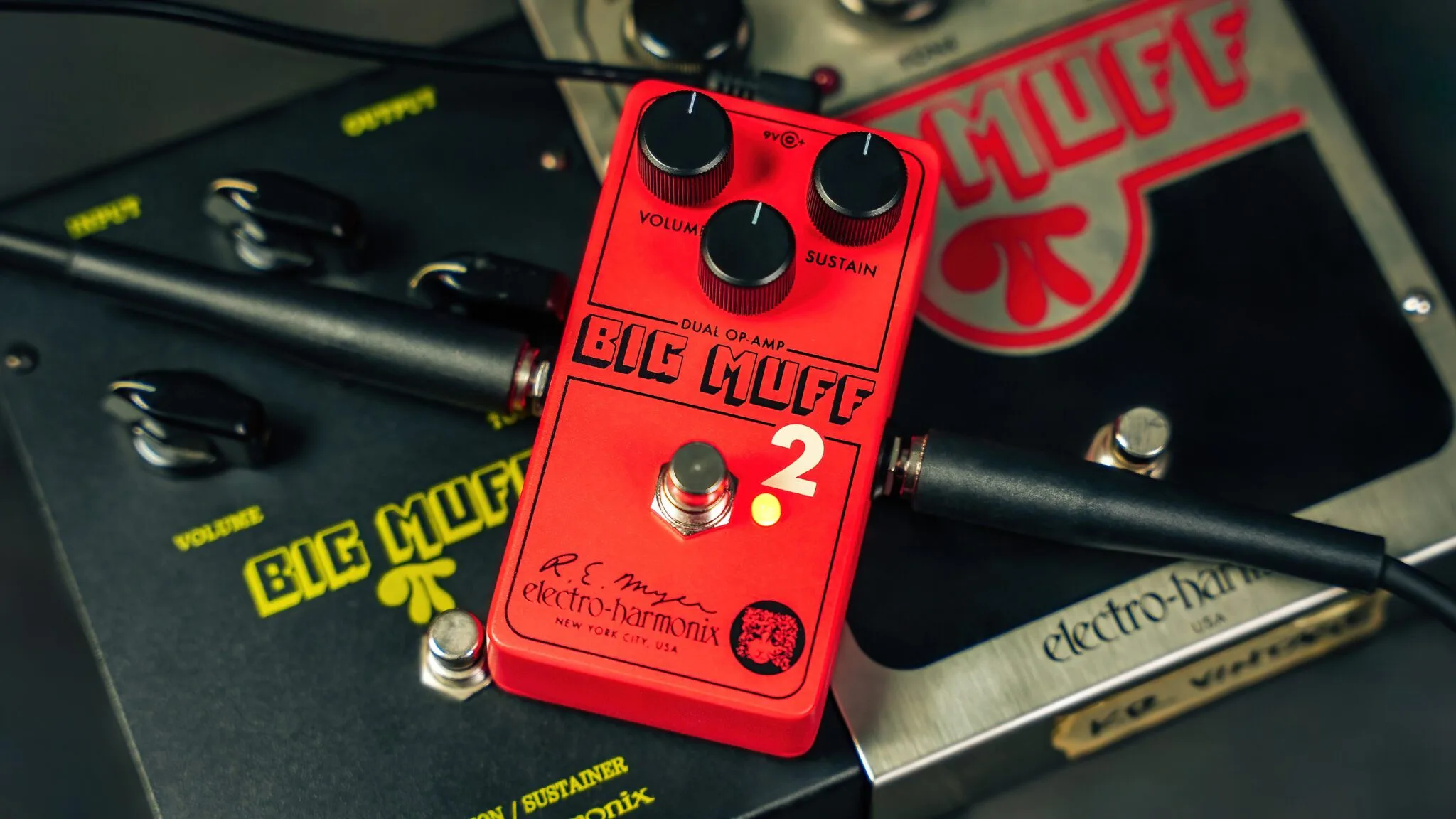
Electro-Harmonix has introduced the Big Muff Pi 2, a new entry in the never-ending Big Muff universe—this time framed around a “lost” Dual Op-Amp Muff circuit concept that didn’t originally become a mainstream release. In a fuzz world overflowing with clones, mods, and boutique takes, EHX going back into its own history (and releasing something positioned as circuit-rooted rather than purely cosmetic) is exactly the kind of gear news that makes players stop scrolling.
Because when a Big Muff changes, it doesn’t just change a pedal. It changes a whole category of guitar tone.
What the Big Muff Pi 2 is (in plain terms)
The Big Muff Pi 2 is a new Big Muff-style fuzz from the company that defined the name. The key “hook” is that it’s tied to a Dual Op-Amp topology—meaning it’s not just another reissue with different graphics; it’s presented as a distinct circuit approach within the Muff family.
If you don’t want the electronics talk, here’s the practical takeaway:
- it’s still a Big Muff: thick sustain, big walls of fuzz, and that familiar “singing” compression
- but it’s aimed at players who want a Muff that feels different in texture and mid behavior than the standard versions
Big Muff variants live and die on how they handle mids, attack, and how well they survive a band mix. The Pi 2 is positioned as a new option in that specific fight.
Why this is news (even if you already own a Muff)
A Big Muff isn’t like most pedals. It’s a “tone identity” pedal—bands build sounds around it. But Muffs also have a common complaint:
They can sound huge alone… and disappear once the drums and bass show up.
That’s why every meaningful new Muff variant is news. Players are always hunting for the version that gives them:
- the size and sustain they love
- without losing definition or vanishing in a mix
- and ideally with a smoother top end that doesn’t turn fizzy on stage
If the Pi 2 shifts the balance in those areas, it becomes a “board contender,” not just a collector release.
The real story: the Muff market is about mids and mix placement
Most Muff conversations are really midrange conversations.
- Classic Muff voicings often have a scooped feel that sounds massive alone.
- In a band, that scoop can fight the reality of guitars living in the mids.
- Players solve it with EQ, boosts, or mid-forward amps—but it’s always a workaround.
So when EHX highlights a different circuit direction, the implied promise is: a Muff with a different mid character and attack response.
Whether you play indie, alt rock, doom, shoegaze, or lead lines with endless sustain, the practical question is the same:
Can I use this Muff without babysitting it all night?
How players will actually use it (real-world workflow)
If you’re considering a new Muff variant, these are the real use cases that matter:
1) The “wall of guitars” rhythm sound
Turn sustain up, keep tone slightly below noon, and let the pedal create the blanket of fuzz. Best for big choruses and heavy riffs.
2) Singing lead sustain
A Muff can act like a sustain engine. The trick is keeping notes present: slightly more mids (via amp/EQ/boost) and slightly less low end than you think.
3) Shoegaze / ambient layers
Muffs excel at turning simple parts into textures—especially when paired with reverb and delay. The risk is mud, so controlling the low end is everything.
In all three cases, the “best” Muff is the one that gives you the sound without forcing you into a complicated support chain.
What it signals about the fuzz/pedal landscape
The Pi 2 fits a bigger trend: players want classic tones, but with modern usability.
You see it everywhere:
- vintage circuits reintroduced with subtle changes to voicing
- classic effects designed to behave better in modern mixes
- “heritage” products marketed with a story (because the market is crowded)
EHX leaning into a historically-rooted circuit angle is also smart branding: it positions the pedal as part of the Big Muff lineage, not just another flavor-of-the-month fuzz.
Who it’s for (and who it isn’t)
Great fit if you:
- love Big Muff sustain but want a different texture/voicing
- play in a full band and need a Muff that stays present
- want a fuzz that can do both massive rhythm and smooth lead sustain
- like the idea of a circuit-based “new chapter” rather than a cosmetic reissue
Maybe not ideal if you:
- only want tight, percussive distortion (Muffs are more “blanket” than “chug”)
- prefer fuzz with lots of cleanup from the guitar volume knob (some Muffs do, many don’t)
- already use a mid-boost/EQ solution you love and don’t need another variant
Bottom line
The Big Muff Pi 2 is news because it’s positioned as a meaningful twist within one of the most iconic fuzz families ever made—aimed at the perennial Muff problem: how to keep the magic (size, sustain, smoothness) while making it more usable in real mixes. If it delivers a new mid/attack behavior that sits better in a band, it won’t just be “another Muff.” It’ll be the version a lot of players were waiting for.
Leave a Reply