
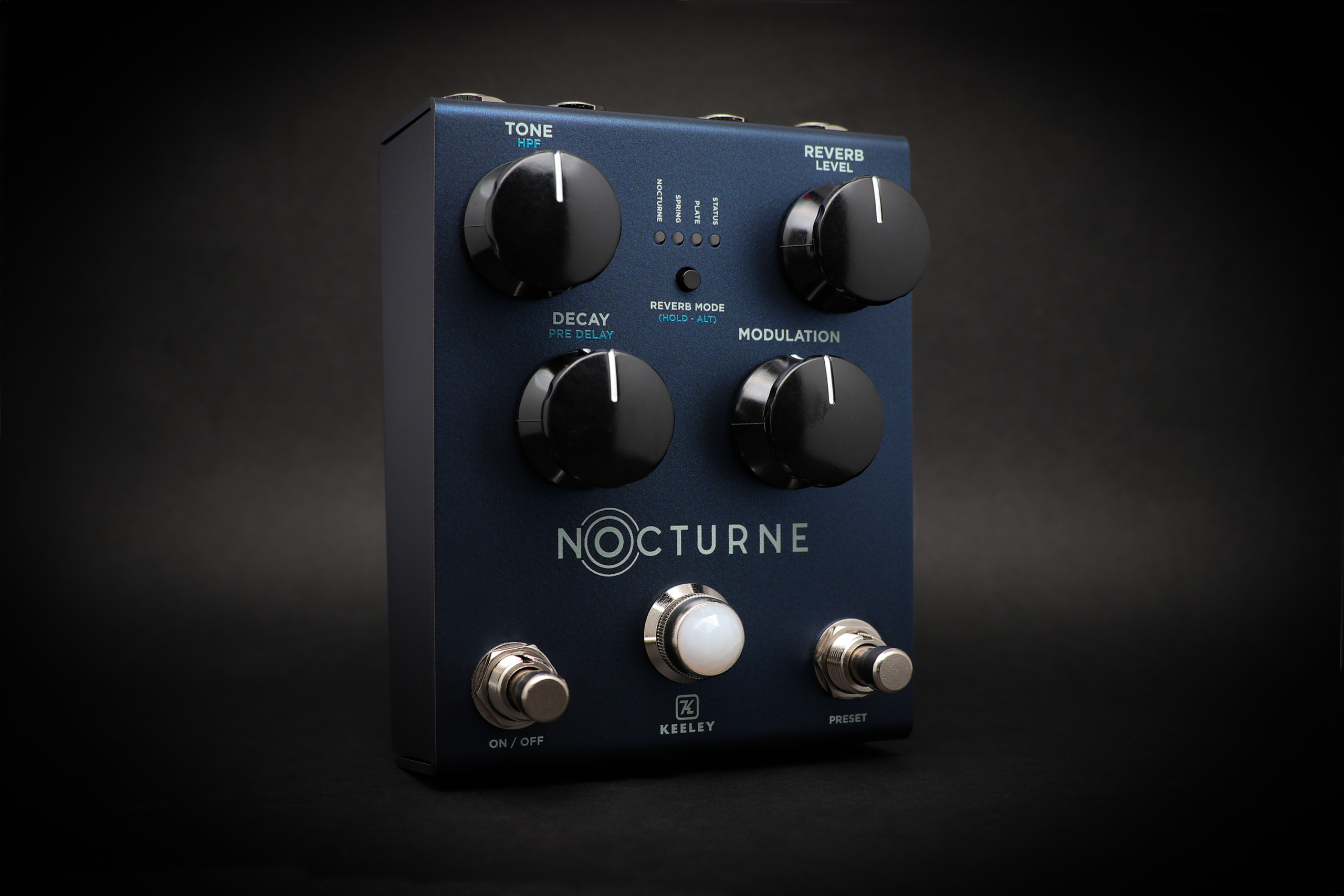
Keeley has expanded its Andy Timmons collaboration with the Nocturne, a dedicated reverb pedal built around a very specific idea: a lush, musical ambience that supports melodic playing without swallowing the note. Instead of being a “do-everything reverb workstation,” Nocturne is positioned as a tone shaper for feel and emotion—the kind of pedal you leave on because it makes everything sound more finished.
In a world where reverbs are often judged by how huge they can get, Nocturne’s headline is more practical: big, expressive space that stays playable.
What the Nocturne is (in plain terms)
At its core, the Nocturne is a signature reverb pedal designed around the ambient character associated with Andy Timmons’ modern lead tone—smooth, dimensional, and cinematic, but still clear enough for phrasing and dynamics.
Think of it as:
- a reverb that adds depth and glow
- without the “wash” that can blur fast lines or chord detail
- with a voicing intended to feel studio-polished and “record-ready” under your hands
This type of pedal is usually less about choosing from 10 algorithms and more about getting one aesthetic exactly right.
Why this is news (even if you don’t play “Timmons-style” lead)
Signature pedals can be hit-or-miss, but the Nocturne taps into a bigger trend: reverb as part of the instrument, not just an effect you add at the end.
More players are building rigs where:
- reverb is always on at a low level (for size and softness),
- then pushed higher for solos or ambient parts,
- and carefully voiced so it works live and in a mix.
That’s especially true in modern worship, ambient/post-rock, film/TV cue work, and melodic instrumental styles—basically anywhere the guitar needs to feel wide and emotional without becoming indistinct.
The Nocturne lands squarely in that “always-on polish” category.
The real target: “lush without mush”
There’s a sweet spot many reverb pedals miss:
- Too dry: the tone feels small and exposed
- Too wet: the guitar loses definition and disappears in the band
The Nocturne’s value proposition is that it’s built to sit in the middle: large enough to feel expensive, controlled enough to stay articulate.
For lead players, that’s a big deal. Your reverb can either:
- flatter your phrasing and make sustained notes sing, or
- smear attacks and turn fast playing into a haze.
A reverb tuned for melodic playing tends to focus on how the reverb tail behaves behind the note, and how the high end is managed so it doesn’t get spiky or grainy.
How players will actually use it (real-world workflow)
Most reverb purchases are decided by what happens in the first 10 minutes: can you dial it fast and does it behave in a band mix?
Here are three practical ways Nocturne-style pedals usually end up deployed:
1) Always-on “finisher” reverb
Set a modest mix, medium decay, and a slightly darker tone. The goal is not “hear the reverb,” but “everything sounds better.”
2) Lead lift without a volume boost
A well-voiced reverb can make leads feel bigger without increasing level—helpful when you don’t want to jump in volume but need the solo to feel special.
3) Ambient pad for intros and transitions
Turn up mix/decay for intro swells, chord washes, and cinematic transitions—then snap back to your always-on setting.
If the pedal is designed right, these shifts are easy and musical, not a fight.
What it signals about modern pedal design
The Nocturne fits a larger direction in boutique pedals: specialized, “one aesthetic done perfectly” boxes.
Instead of giving you:
- 12 reverb types
- menu systems
- endless parameter pages
…these pedals aim to deliver:
- a signature voicing
- quick dials
- consistent results
That’s a response to how most players actually gig and record: they want repeatable tones that don’t require engineering brain to operate.
Who it’s for (and who it isn’t)
Great fit if you:
- want an always-on reverb that makes your rig feel bigger and smoother
- play melodic leads and care about note bloom and sustain
- build ambient moments into sets (intros, transitions, swells)
- want “studio polish” on a pedalboard without deep editing
Maybe not ideal if you:
- want tons of different reverb algorithms in one unit
- prefer super-bright, ultra-sparkly reverb textures
- need extreme experimental sound design over musical subtlety
- already run big ambient reverbs in stereo and want maximum control
Bottom line
Keeley’s Nocturne is news because it’s not trying to win on feature count—it’s aiming to be the kind of reverb that immediately makes your guitar sound more finished, especially for melodic and expressive playing. If it delivers on “lush without mush,” it’ll earn the best kind of reputation: the pedal you stop thinking about because it just works.
Leave a Reply